


A little birdie at our farmland told us that you are thinking of buying a piece of agricultural land. Honestly? Smart move! But hold on before you sign on the dotted line, as there is one thing you absolutely must check: the soil.
Yes, we are talking about the earth beneath your feet because the importance of soil testing cannot be overstated when you’re buying farmland. You might fall in love with the view, the location, the amenities, but if the ground is tired, infertile, or full of hidden issues, your dream could turn into a slow-burning regret.
That’s why we are here to walk you through why soil testing is important, what you’ll be checking, and how using proper agricultural soil testing methods for soil analysis for agriculture can save you from a world of trouble. Let’s dig in (pun intended)!
Why Soil Testing Is Crucial Before Buying Agricultural Land
Here is the heart of the matter. You might think location, amenities, and connectivity are everything, which, well, you are not wrong about. But we will tell you exactly why soil testing is important:
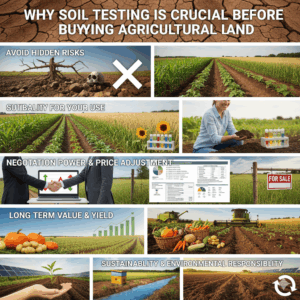
- Avoid Hidden Risks
Want to know the worst-case scenario of it all? You could actually end up with soil that is saline, contaminated, poorly drained, or even worse, nutrient-deficient. This is exactly where understanding the importance of soil testing becomes very real!
- Suitability for Your Use
Maybe you want to grow fruit trees, vegetables, or just use the land for a weekend farm retreat. Well, a proper soil test for agriculture will help you know whether the land is actually aligned with your intended use or not.
- Negotiation Power & Price Adjustment
Let’s say your soil report shows some problems. Don’t worry, it’s not the end of the world. However, you can actually use that in negotiations or budget for remediation. That’s your power and your right! We mean, why would you pay the whole price for a sub-par ground?
- Long-Term Value & Yield
One thing you should remind yourself of is that land is not just for now. You are hoping for appreciation, yields, and maybe a passive income. And what this soil analysis for agriculture reveals might affect the long-term value of your land.
- Sustainability & Environmental Responsibility
Today, more than ever, buyers care about a sustainable land that appreciates. So with proper agricultural soil testing methods, you can have a great base for your sustainability story too!
Key Parameters Checked In Soil Analysis For Agriculture
Okay, so you’ve decided a soil test is non-negotiable. What exactly do you check for? Here is a table with some of the core parameters when you do a soil test for agriculture, and what they tell you:
| Parameter | Why It Matters | Good/Warning Range (approx) |
| pH (soil acidity/alkalinity) | Determines nutrient availability & microbial activity | 6.0-7.5 is good; <5.5 or >8 warning |
| Macro-nutrients (N, P, K) | Nitrogen, phosphorus, potassium are core for crop growth | Region/crop dependent; very low = warning |
| Micronutrients (Zn, Fe, Mn etc) | Small amounts, big impact | Deficiencies common in Indian soils |
| Organic matter / humus | Soil health, water retention, fertility | >2% is better; <1% is weak |
| Texture / structure | Clay/silt/sand mix – affects drainage, root penetration | Good loam = ideal |
| Salinity / EC | High salt = crop stress, poor yields | EC < 2 dS/m in many cases |
| Heavy metals / contamination | Especially if land was industrial/used previously | Must be near zero in safe farmland |
Common Mistakes & Risks If You Skip Soil Testing
You want us to be blunt? Here you go! Skipping a soil test is a mistake, and below are all the things many land-buyers miss, which can cost them a lot. This list will also tell you why soil testing is important:
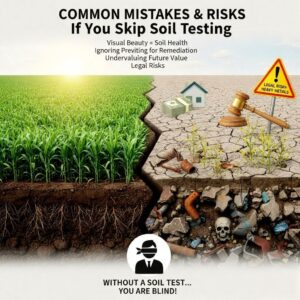
- People often assume that visual beauty = soil health. So even if the land looks green to you, remember, beneath the surface, the soil could be depleted. And without a proper soil test for agriculture, you are blind!
- Ignoring the previous land use also tops the list, as who knows, it could have been used for industrial, or dumped soil, or heavy grazing. Without a soil analysis for agriculture, you are inviting contamination.
- Another mistake is not budgeting for remediation, like soil might need work, and so you’d better perform proper agricultural soil testing methods instead of paying later!
- Undervaluing your future value is not a smart choice! Poor soil = low productivity = lower resale or rental value.
- There can also be legal risks, like if heavy metals are present and you didn’t test, you might face regulatory baggage.
Also Read : Is Agricultural Land Still a Good Investment in 2025?
Checklist: Steps You Should Follow
Alright, now let’s get practical. Here’s your buyer-friendly step-by-step checklist for soil testing for agriculture before buying land. This is your actionable guide, so print it out if you wish to and keep checking while you go through the process of soil testing:
- Request Existing Soil Test Report
You can ask the seller or the developer if a recent soil report is available. Following up, you can also ask questions about the last time the land was tested, what they found, etc. This is why you can address the question of why soil testing is important right off the bat!
- If No Report, Commission A Fresh Test
Make sure you are using the correct agricultural soil testing methods, that is, collecting samples at 0-20 cm depth (common for crops), from multiple spots across the plot, and mixing them into a composite sample. You will have a full report of pH, macro and micro nutrients, organic matter, salinity, texture, heavy metals, etc.
- Interpret The Soil Analysis For Agriculture
Once the results are in your hand, you can then check how the parameters stack up vs your planned usage (fruit trees, veggies, mixed farming).
- Ask About Remediation / Land Management
If issues are found, ask: What will I need to do? How much will fixing cost?
- Negotiate Accordingly
If the soil test reveals problems, and you know you can have your way around it, then well, you have negotiation leverage! This means you can get lower prices or ask the developer to fix it before closing.
- Document & Archive The Soil Report
For legal purposes, you should keep a copy of the soil test report for your records. This is because the future buyer or bank might ask for it!
- Plan Your Land Use Aligned With Soil Results
If your test shows the land is ideal for one crop (say, fruit trees) but weak for another (say, veggies), then you should think about aligning your plan accordingly.
- Monitor Over Time & Maintain Soil Health
Always keep in mind that good soil isn’t “buy and forget”. It actually needs maintenance: crop rotation, organic matter, drainage, etc. If you’ve used agricultural soil testing methods properly at the start, then you will have a solid baseline.
Also Read : How Does Managed Farmland Work? A Step by Step Guide for First Time Buyers
Final Thoughts
So there you have it: Everything you need to know bout why soil testing is important before being the actual agricultural land. And we get it! At first glance, the land might look idyllic, the location perfect, and the amenities lovely. But the ground underneath? That’s where the real story lies. A proper soil test for agriculture, backed by thoughtful agricultural soil testing methods and solid soil analysis for agriculture, lets you buy confidently rather than optimistically.
And for us as SBC Earthfulness, we are all about offering managed farmlands that are cultivated with a thoroughly curated mix of fruit-bearing trees and native flora. So yes, we do contribute a lot to biodiversity. Remember: the importance of soil testing isn’t just about crops. You should think of it more like an investment, sustainability, enjoyment, and without a doubt, a legacy.
Basically, you are buying a slice of land that might feed your family, host your weekend home, or become a generational asset. So, start it right, for the reasons. At last, when next time you step onto that pasture, field, or plot, imagine your future farmhouse, and pause. Ask for the soil test, ask for the numbers. Because believe us, you will thank yourself later when the land yields are not just beauty, but also bring value and peace of mind.