

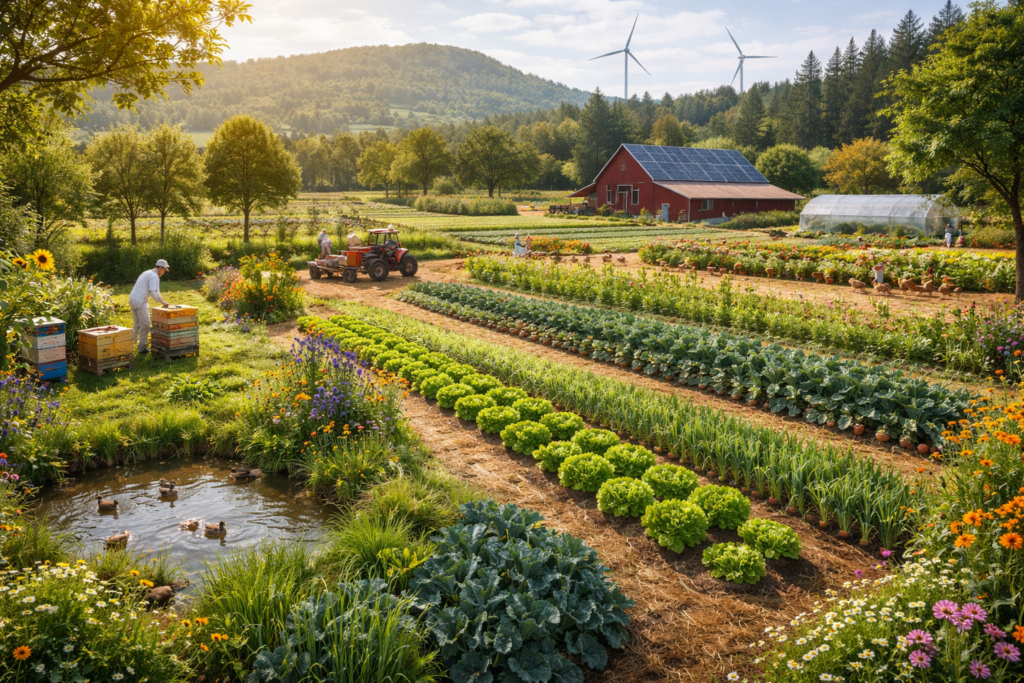

At a certain point, the idea of farmland starts to mean more than just the ownership of land. It feels like land where the soil is alive, where trees grow naturally, and where farming does not harm the environment.
Due to this, people today are looking at the relationship between organic farming and biodiversity and the ways through which modern farmland can offer this.
Traditionally, farming practices have been more focused on productivity and have often had to use chemicals to do so. Today, the change is very obvious.
People are no longer looking for land where crops grow; instead, they are looking for land where the ecosystem can thrive. Thus, the question is rather simple.
What is the contribution of managed farmland to the long-term maintenance of practices such as organic farming and biodiversity conservation?
Why Organic Farming and Biodiversity Are Closely Connected
It is necessary to understand the relationship between organic farming and biodiversity conservation.
Organic farming is not merely the absence of chemicals; rather, it is the use of nature instead of going against it. When chemicals are not a part of the equation, the soil starts to improve, and nature slowly starts to rebuild itself.
Biodiversity is an extremely important part of this equation. A farm’s biodiversity does not merely include crops; rather, it includes trees, insects, birds, and even the soil.
Each one of these components is essential for the creation of a balanced ecosystem. Bees help crops grow; birds help control pests; and microbes improve the soil’s fertility. When biodiversity is high, farming becomes more sustainable and self-sufficient.
In simple words, organic farming develops an environment for biodiversity to flourish.
What Makes Managed Farmland Different
The biggest challenge with sustainable farming is to ensure consistency. Organic farming involves meticulous planning and monitoring.
It demands a good understanding of ecology. As an individual, managing all of this might be too daunting. This is where managed farmland makes a huge difference. Managed farmland lets an individual own land and still get all farming activities handled by experts.

Experts handle every aspect of farming, be it land preparation and plantation planning, irrigation, and crop cultivation. This ensures sustainable farming practices do not remain confined to theory.
This is precisely where the farmland management system of SBC Earthfulness has a clear advantage. Instead of focusing on the ownership of the land, this method is based on creating an ecosystem that improves with every passing year.
This structured and expert-based model is far easier for implementing eco-friendly farming techniques in farmlands without any compromise on the overall efficiency and productivity.
How Managed Farmland Strengthens Organic Farming
The real strength of the farmland management model is that it provides a strong ground for implementing organic farming techniques. Unlike conventional farming, which is based on the immediate outcome of the farming process, the farmland management model is based on the overall health of the soil.
The soil is the primary source of organic farming, and this is where the farmland management model has invested a lot in order to improve the overall health of the soil through natural means such as composting, green manure, and microbe enrichment.
In the case of managed farmland, natural methods are used for pest control, fertilization, and rotation of crops for maintaining the fertility of the soil and the health of the crops.
This not only results in the production of healthy crops but also ensures that the environment surrounding the farmland does not get affected in any way.
Understanding Agroforestry and Its Benefits
A major factor in the context of sustainable farmland is agroforestry and its benefits, which play a vital role in ensuring that productivity and biodiversity are increased significantly. Agroforestry can be defined as a practice where trees are grown along with crops on the same plot of land, thereby creating a multi-layered ecosystem.
This method contributes to soil enrichment by adding organic matter and nutrients. Additionally, they protect the soil from erosion by their roots.
This shade protects against temperature fluctuations and reduces water loss. The agroforestry benefits do not stop there.
Agroforestry is also beneficial to the land. This means that once an area of land is used for agroforestry, there is no need to worry about climate changes. This makes agroforestry a powerful method for creating sustainable and productive land.
At SBC Earthfulness, agroforestry is carefully incorporated into land to ensure that every piece of land is contributing to a sustainable ecosystem.
Eco-Friendly Farming Methods in Farmlands
To completely support the idea of sustainability, managed farmland uses different methods of eco-friendly farming on farmlands, which are not only good for the environment but also feasible for long-term use.
Water management can be done by using methods such as rainwater harvesting, which ensures that water is used in the best possible way.
Another method is natural pest management, which ensures that pests are controlled without harming other useful species in the environment. This can be done by using neem-based pesticides, which are environmentally friendly.
These methods are important in ensuring that the soil is well maintained for future use, as well as ensuring the productivity of the crops grown in the farmland.
Benefits of Biodiversity in Managed Farmland
Managed farmland offers the best conditions for biodiversity to flourish because, in its development, biodiversity was taken into consideration.
This type of farmland does not require the complete clearing of the environment, as the natural components are left in place.
Natural trees and other flora are left in place, offering a habitat for birds and other insects, which in turn promotes natural pollination and control of pests without the use of external control methods.
The absence of chemicals also ensures that the soil and water are healthy, thereby promoting biodiversity in the environment. This type of farmland is created where farming takes place with the aim of healing the environment.
Final Thoughts
Farmland today is changing into something more meaningful than an ordinary investment. It is an opportunity to reconnect with nature and contribute to sustainable practices.
The concept of managed farmland makes this transition possible by giving an individual the structure and expertise to successfully implement organic farming and biodiversity-focused practices.
It reduces the hassle of farming while ensuring that the land grows even healthier over time. So, if you think about owning a piece of farmland, it is worth asking yourself not only what this land can do for you but also what this land can become.
Frequently Asked Questions
1. How does managed farmland help with organic farming and biodiversity?
Managed farmland provides professional expertise that ensures the proper implementation of organic farming methods, which are beneficial for biodiversity.
2. What are some of the main benefits that agroforestry provides for farmlands?
Agroforestry provides fertility to the soil, prevents erosion, promotes biodiversity, and provides a resilient farming system.
3. Are eco-friendly farming methods in farmlands effective?
Eco-friendly farming methods are effective in that they help with soil fertility, conserve water, and create a sustainable farming system that is efficient.
4. Can a beginner invest in managed farmland?
Of course, a beginner can invest in managed farmland because experts handle all the farming activities.
5. Why is biodiversity important for sustainable farming?
Biodiversity is important for sustainable farming because it promotes pollination, pest control, soil fertility, and ecosystem sustainability, making farming efficient.