

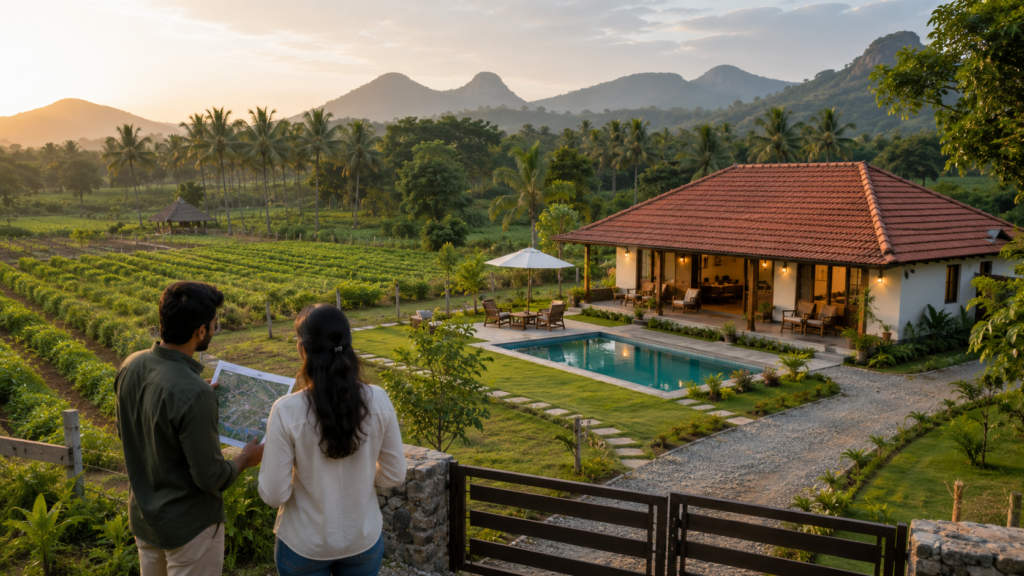

The dynamics of the hospitality sector in Southern India have changed considerably. Today, tourists do not require lavish yet uniform hotels and overcrowded hill-station hotels. What travelers really need today are serene getaways where one could wake up to the sounds of peacocks chirping and drink filter coffee in the company of peacocks, with the added bonus of a complete digital detox amidst natural orchards.
The above change in culture has created another golden opportunity for investors—the agritourism resort. If done right, agritourism ensures high returns from the farm land rental income in Tamil Nadu and the appreciation of the core asset over time.
If you wish to cash in on the above trend, read below to understand how to buy farm land in Tamil Nadu.
Location To Purchase: Hot Corridors Of Hospitality
For you to be able to secure premium nightly prices for your farm stays through online booking services such as Airbnb, purchasing land at the lowest available price is something that you simply cannot afford. The property should be located with a good mix of distance from the city as well as easy access.

Here are some hot corridors where you should consider before you buy farm land in Tamil Nadu:
- Western Foothills (Pollachi, Coimbatore Peripheral, Tenkasi): These corridors provide stunning views of the mountain range, fertile red soil, and favorable ground water. These places are highly preferred by travelers from urban settings who are looking for a place that provides cool climatic conditions and natural paths.
- Spiritual And Heritage Corridors (Tiruvannamalai, Kanchipuram Outer, Tanjore): These places attract many visitors who are interested in living in a slow pace of life.
- Coastal Or Weekend Escape Corridors (ECR Outskirts, Pondicherry Borders, Marakkanam): Places that are highly favored by people in Chennai as weekend destinations.
Understanding Legal Verifications To Buy Farm Land in Tamil Nadu: The Nanjai vs. Punjai Principle
Before putting in an offer on farmland for sale in Tamil Nadu, it is imperative to comprehend the strict categorization of agricultural lands by the Tamil Nadu government. This categorization is responsible for setting your entire construction agenda right from the very beginning.
Nanjai (Wet Land)
They are highly fertile farmlands supplied directly through rivers, dams, or government canals. In order to safeguard their food security, the Tamil Nadu government has set up stringent regulations when it comes to building structures on Nanjai farmlands. Building structures for hospitality purposes is extremely difficult and highly unlikely to receive any approvals whatsoever. It is better not to consider a farm stay project on Nanjai land.
Punjai (Dry Land)
The source of supply in such farmlands can either be rainwater or private borewells. Since it does not rely on critical government irrigation canals, its structural advantages cannot be understated. The process of acquiring building permits in Punjai farmlands is much simpler and easier than anything else.
Design Playbook: Comfort with Rustic Elegance
Airbnb customers today would rather stay in a villa constructed in the heart of a field than a suburban one. You must incorporate the vernacular architectural style to maximize your income from the farm land rental income in Tamil Nadu.
Incorporate Climate-Responsive Architecture
Use indigenous materials like exposed brick (wire cut), Athangudi tiles, and sloping tiled roofs (Odu). These will give a great visual appeal on social media while delivering a higher thermal mass that keeps the building interior cool all summer long.
A Turnkey Solution: Purchasing Properties Ready for Hosting
If you are an investor looking for opportunities to profit from the lucrative Airbnb farmstay space but do not wish to be weighed down by the daunting pressure of overseeing off-site construction, landscaping, and facility construction, then a managed community with a focus on hospitality is your absolute solution. For instance, platforms such as SBC Earthfulness, which has a premier 200-acre property known as A Walk in the Clouds (situated in the beautiful high-groundwater area of Denkanikottai), are practically constructing agritourism communities.
Through purchasing Punjai land in an estate equipped with existing guest amenities such as chemical-free biopools, a restaurant serving organic food, a stargazing deck, and an amphitheater, you can instantly create a high value experience for visitors at your own farm cabin. Your marketing efforts will go beyond promoting one cabin in isolation, but instead providing visitors with a full experience of a “rural-luxe” vacation, complete with professional management and round-the-clock security services.
Leverage The 90/10 Land Split Strategy
In order to preserve the agriculturally idyllic setting, the build-up land area must stay below 10% of the entire piece of land owned. The rest 90% of the land area will be dedicated to intensive plantation of timber trees (such as Teak or Mahogany) and fruits (such as mango, guava, and coconut). Your guests will step out of their luxury cabin directly into the fruit orchard!
Monetization Matrix: Income Sources beyond Airbnb Nightly Rates
Successful agritourism farms have more sources of income than just renting out bedrooms via Airbnb. You can generate various revenue streams with just one land plot using an integrated farm strategy.
| Income Stream | Targeted Audience | Revenue Mechanics |
| Airbnb & Booking.com | Couples, Families, Tech Professionals | High weekend night rates; steady seasonal occupancy. |
| Daycations & Photoshoots | Local Influencers, Pre-wedding Shoots | Flat hourly/daily venue rental fees with zero overnight overhead. |
| Farm-to-Table Retail | In-house Guests & Digital Subscribers | Selling cold-pressed coconut oils, organic fruits, and ghee directly. |
| High-Value Timber Capital | Long-Term Asset Appreciations | Harvesting Teak/Mahogany trees over a 10-to-15-year cycle. |
By treating your farm stay as an ecosystem rather than just a rental room, you insulate your cash flow from seasonal tourism dips and maximize your total rental income from farmland.
Agritourism Due Diligence Checklist To Buy Farm Land in Tamil Nadu
In order to safeguard your investment while searching for farm land for sale Tamil Nadu, make sure that your legal counsel approves all points of this agritourism due diligence checklist:
- Digital Patta Authentication: Visit the Any TamilNadu e-services website to make sure that the digital Patta aligns precisely with the identity of the seller.
- 30-Year Record of Encumbrance: Obtain a complete record of the Encumbrance Certificate (EC) from the TNREGINET site to verify that there are no open bank loans or any pending inheritance cases against the land.
- FMB Sketch Comparison: Verify the alignment of the boundaries by conducting a survey using an authorized surveyor to ensure that it corresponds with the field measurement book (FMB).
- Width of Access Roads: Make sure that there are legal access roads that are sufficient enough for traveling SUVs and construction vehicles.
- Commercial Development Approval: Make sure that the relevant authorities, such as the Village Panchayat/DTCP, provide the necessary clearances for commercial development as per the Tamil Nadu Change of Land Use Rules.
Conclusion
To buy farm land in Tamil Nadu would be the perfect blend of asset preservation and income production. This is achieved through choosing a visually pleasing dry land site in Punjai on an already established travel route, respecting the indigenous architecture designs, and providing a truly authentic farming experience for visitors.
FAQs
Q1. What are the necessary approvals needed for conducting a business venture using Airbnb on farm land in Tamil Nadu?
Approval under Tamil Nadu Change of Land Use Rules needs to be sought via local DTCP/Panchayat routes, and other tourism and fire safety clearances need to be obtained.
Q2. Is it permissible to construct concrete structures on any available farm land for sale in Tamil Nadu?
Preference should be given to Punjai lands for any construction activity, whereas construction on Nanjai lands is severely prohibited by the state in order to ensure food security.
Q3. How much money can one make annually renting out farm lands in Tamil Nadu?
According to the aesthetic sense of the landowner and closeness to large metros, a well-promoted boutique farmhouse stay can charge anything between ₹5,000 and ₹15,000 per night.