


There has been a marked trend in urban professionals and NRIs towards the buying of agricultural land in Tamil Nadu in the last few years. People are seeking hard assets, secure and green investments because of increased fears of market volatility, inflation, and sustainability; farmland would be an apt answer to these requirements.
But not all people have the know-how and time to maintain a farm independently. This is where investing in managed farms comes to their rescue, giving them a hassle-free way of owning property while professionals take care of daily operations.
Even if this concept appears interesting, purchasing a farming investment is less straightforward than purchasing an apartment in the city. There are regulations, risks, and limitations particular to agricultural land. Due diligence is thus important, especially when investing through a farmland management company.
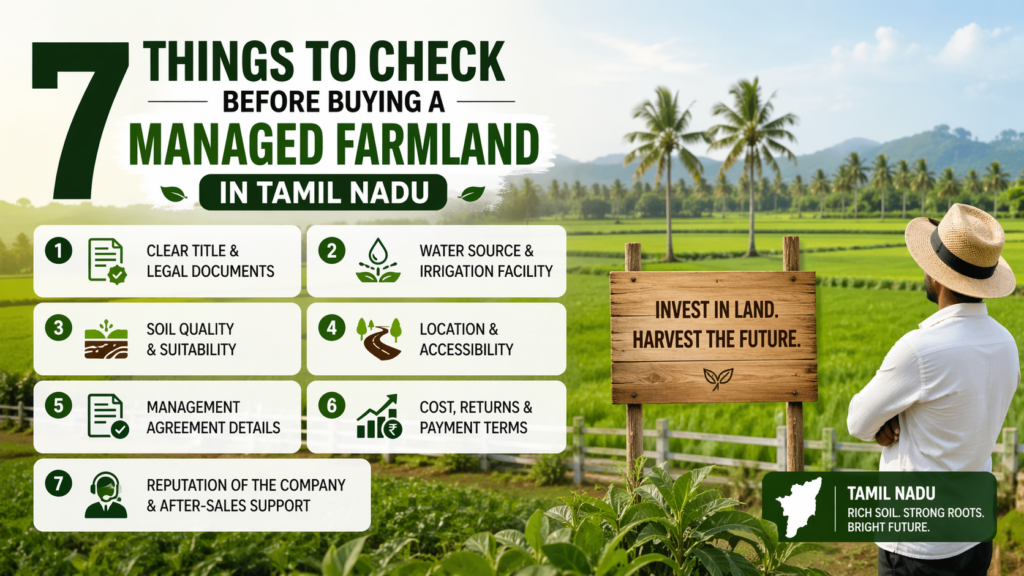
This article sets out seven key points you might want to consider before investing in managed farmland in Tamil Nadu.
Legal Title and Land Ownership Verification
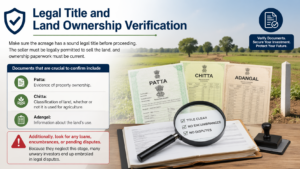
- Make sure the acreage has a sound legal title before proceeding. The seller must be legally permitted to sell the land, and ownership paperwork must be current. Documents that are crucial to confirm include
- Patta: Evidence of property ownership.
- Chitta: Classification of land, whether or not it is used for agriculture.
- Adangal: Information about the land’s use.
Additionally, look for any loans, encumbrances, or pending disputes. Because they neglect this stage, many unwary investors end up embroiled in legal disputes.
Why it matters: Prevents legal issues and guarantees the security and legitimacy of your investment in Tamil Nadu.
Land Use Classification and Zoning Laws
Legally, not all of Tamil Nadu’s land can be used for farming. You need to confirm that the property is
- Categorized as agricultural land (not commercial, industrial, or forest).
- Not classified as reserved or protected.
- According to the rules of the Local Planning Authority (LPA) or the Directorate of Town and Country Planning (DTCP), if it is within the planning boundaries.
Furthermore, there are limitations on non-agriculturists buying agricultural land in Tamil Nadu. Verify that the farmland company’s ownership structure complies with regulations.
Why it matters: If your entire investment is not compatible, certain lands may be limited or require approvals.
Soil Quality and Water Availability
The agricultural potential of the land determines how profitable your managed farmland investment will be. Here’s what to look for:
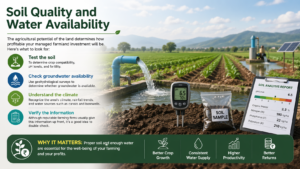
- To determine crop compatibility, pH levels, and fertility, test the soil.
- Use geohydrological surveys to determine whether groundwater is available.
- Recognize the area’s climate, rainfall trends, and water sources such as canals and borewells.
- Although reputable farming firms usually give this information up front, it’s a good idea to double-check.
Why it matters: Proper soil and enough water are essential for the well-being of your farming and your profits.
Proximity to Infrastructure and Market Access
Accessibility is crucial but frequently disregarded. Examine:
- The distance to local markets, power lines, and major roads.
- Proximity to important cities that affect land appreciation, such as Madurai, Coimbatore, or Chennai.
- Access to logistics for transportation and storage facilities for the distribution of crops.
Why it matters: A farm with good connections is more manageable and has more operational and resale value.
Credibility of the Managed Farmland Company
Purchasing managed farmland entails more than simply purchasing land; it also entails entrusting a business to care for and expand it on your behalf. Do a comprehensive background investigation. Trusted platforms like SBC Earthfulness are known for offering transparency, consistent performance, and end-to-end support.
- Examine the years of operation and track record.
- Request case studies and client endorsements.
- Recognize the services they offer, such as crop management, revenue sharing, stay experiences, legal support, etc.
- Confidence might be increased by visiting the real location or talking to other investors.
Why it matters: Peace of mind, steady yield, and transparency are guaranteed by a trustworthy farmland firm.
Compliance with Tamil Nadu Land Reforms
Under a number of changes, Tamil Nadu has particular landholding limits. Important rules consist of
- Restrictions imposed by the Tamil Nadu Land Ceiling Act on the amount of land that a single person or organization may own.
- Corporations or non-farmers who wish to own agricultural land must adhere to specific regulatory requirements.
- Ownership may be revoked or confiscated for any infraction.
Find out from the farmland supplier how the landholding is organized, including if it is a cooperative, lease, or partial ownership, and make sure it complies with the law.
Why it matters: Failure to comply with regulations can have serious financial and legal repercussions.
Expected Returns and Exit Strategy
Lastly, learn about the financial model. Every managed farmland investment firm will have a different strategy for making money. Be explicit about:
- How money is made (e.g., cash crops, fruits, timber, agricultural tourism).
- Annual reports, revenue-sharing schemes, and ROI expectations.
- Your choices for leaving: Is it permitted to resell? Do lock-in periods exist?
- Despite being a long-term asset, farmland nevertheless requires a clear exit strategy.
Why it matters: Better financial planning and a reduction in disappointment are made possible by having realistic expectations.
To wrap up
More people are considering buying farmland in Tamil Nadu as a safe and lucrative choice as awareness of passive income and ecological living grows. The difficulties are as real as the advantages. A successful endeavour or a tragic error can be determined by thoroughly researching legal titles, compliance, location, soil quality, and the agricultural firm.
Recall that managed farmland investment is about owning a carefully considered ecosystem that develops over time, not just land.
Look no further than SBC Earthfulness if you’re thinking about making an investment in farmland and want a reliable partner to help you manage the property, provide guidance, and help you generate sustainable earnings.