


The purchase of a piece of land is a serious financial investment. The plot which is too large can cause difficulties with money for development, protection, and utilities. In case the plot is too small, it won’t provide the necessary spatial needs. However, finding the right balance will require an approach.
In this guide, you will learn about the choice of farm plot sizes on the basis of your budget. You will find information about types of plots in farm developments, the market of commercial farm land for sale, and hidden costs.
Why Farm Plot Size Matters for Your Budget?
People who think about a land budget consider only the initial cost of purchasing the plot. But the physical land plot directly influences the cost of maintenance and holding of the land.
Additional land plot acres demand additional maintenance. Maintenance includes construction of fence lines, building roads, marking boundaries, weed clearance, and land stabilizing. If you purchase an expansive plot of land but do not have enough resources for development or protection, then it is unproductive land for you, which still costs you money as tax on the property.
Common Types of Plots in Farm Estates
To determine how to select your farm plot size, you first have to learn about the conventional types of plots available in a typical farm subdivision or rural setting. Farmlands are usually classified according to their size and functionality.
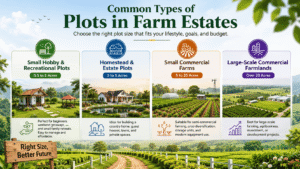
Small Hobby and Recreational Plots (0.5 to 2 Acres)
If you are a beginner, weekend getaway type of person, or family that wishes to have a small country getaway, then such small plots will serve your purpose well. Managing a plot of 1 acre is quite easy without having to hire any property management company or buying any farming equipment. Such plots are inexpensive to buy but not very scalable from a business perspective.
Homestead and Estate Plots (2 to 5 Acres)
A plot of 2 to 5 acres offers sufficient land to construct a big enough country house, guest houses, extensive lawns, and water bodies. Such plots are quite popular among people who wish to be far away from their neighbors.
Small Commercial Farms (5 to 20 Acres)
This kind of property is an intermediary category between amateurism and professionalism in farming. The land plot is large enough to enable the division into smaller sections, the creation of large warehouses, or even lease of certain land parcels. You will have to buy mechanized farm equipment, as well as automatic watering devices.
Large-Scale Commercial Farmlands (over 20 Acres)
These lands are designed for extensive commercial usage or real estate construction on an industrial scale. In case of land purchase intended for institutional investment or major commercial ventures, you will be interested in buying commercial farmlands. The purchase and legal zoning of such a plot requires great capital investments.
How to Choose Farm Plot Size: A Step-by-Step Guide?
Selecting the appropriate land size is a mathematical calculation that factors in your purposes in using land against the money you have. Follow the guidelines below to assist you.
Step 1: State Your Main Purpose in Using the Land
- Why would you be purchasing land? This will determine how large an area you need based on what it takes to finance it.
- Weekend Home / Villa: The ultimate comfort can be gained in 0.5 to 1.5 acres.
- Family Residence / Compound: Where you intend to build several structures for your family, a 3-to-5 acre structure gives everybody enough space.
- Investment in Commercial/Resale: For future sub-divisions of the land, you will need more acreage such as 10+ acres.
Step 2: Calculate the Total Cost of Ownership
Do not allocate your entire budget to purchasing raw land. The general rule that can be followed is called the 60/40 Rule, which means allocating 60 percent of the budget to the purchase of the land and the rest to the other expenses.
On having an overall budget of ₹50,000,000, the allocation will be as follows:
| Expense Category | Budget Allocation | Purpose |
| Land Purchase | ₹30,000,000 (60%) | Down payment, registration, stamp duty, and land cost |
| Infrastructure | ₹10,000,000 (20%) | Boundary walls, fencing, water wells, electricity connection, roads |
| Maintenance & Taxes | ₹10,000,000 (20%) | Security guards, clearing, annual taxes, legal insurance |
If you go for a huge plot utilizing all your funds, you would only end up with a piece of land that is not only insecure but also inaccessible.
Don’t MIss : Advantages of Owning Farmland Near Bangalore for Weekend Living
Step 3: Consider the Maintenance and Labor Requirements
Take into account who will ensure security and maintenance of the land.
- One acre can easily be handled by one family using basic fences and equipment.
- If you have over 5 acres, then you will definitely need the services of security personnel or maintenance machinery. Expenses will be incurred clearing overgrowth, repairing fences, and maintenance of internal roads. You should maintain a small plot of land if your budget cannot accommodate such expenses.
Analyzing Commercial Farm Land for Sale
If you are considering buying farmland commercially, you are investing in an asset for your portfolio. Commercial land investments demand geographic efficiency.
According to studies conducted by the Indian Institute of Management Ahmedabad (IIMA), proximity to large cities and future highway projects strongly influence land appreciation prices. Farmlands that are close to economic centers are more expensive initially, but they enhance resale liquidity and rent.
Here are some features to consider when searching for commercial plot investments to keep your investment safe from financial risks:
- Topography and Terrain: Rough terrain or rugged landscape will require you to spend an astronomical amount on construction machinery to prepare the site.
- Existing Utilities: Choose the plots that have the following existing infrastructure – perimeter fences, legal road access, or electricity transformers. Construction of such infrastructures can quickly wipe out your development budget.
- Zoning Regulations and Water Rights: Ensure that the land has a clean title deed and access to the groundwater tables.
Hidden Costs That Affect Your Budget
In search of how to select farm plot size, buyers fail to consider some hidden costs that could affect the amount of land they can afford.
1. Water Supply and Utilities
Land requires utilities. When your plot does not have an efficient source of water supply, you will be forced to dig a well or build a water supply system. The drilling of a borehole can be quite expensive. A bigger piece of land will entail long pipes, wiring, and electricity charges for servicing its entire perimeter.
2. Boundary Walls and Security
While security is a function of perimeter length and not plot size, it becomes more expensive on a bigger plot. A 10-acre plot will cost significantly more in terms of boundary walling material than a 2-acre plot. It could even cost millions of rupees in some cases.
3. Property Taxes and Insurance
Bigger land plots also mean higher property tax costs annually. Also, you will require comprehensive property insurance for protection against extreme weather conditions, land invasion, and lawsuits.
Budget Matrix: Allocating Funds According to Land Plot Size
This is a budget matrix to assist you in allocating funds according to land plot size for easy planning.
| Available Budget | Recommended Size | Best Property Types | Expected Infrastructure |
| Low Budget | Under 2 Acres | Weekend cabin, small hobby plot, private orchard space | Basic wire fencing, manual gates |
| Medium Budget | 2 to 10 Acres | Family country estate, private compound, villa layout | Brick boundary walls, deep borewell, internal roads |
| High Budget | 10 to 50 Acres | Commercial land bank, private eco-resort site | Gated entrance, transformer setup, paved roads |
| Corporate Budget | 50+ Acres | Institutional land investment, township potential | Full security grid, heavy earthmoving, drainage networks |
Conclusion: Start Small and Expand Later
In determining farm plot size, it is always better to opt for a smaller, quality plot of land rather than a larger one that may prove difficult to manage. Managing a smaller estate successfully helps you understand how to manage security and utilities as well as the climate of the region. Once you develop a smaller piece of land to perfection, you can then utilize your leftover capital to purchase the adjacent pieces of land or commercial farm land for sale.
Sustainable Option: In case managing an independent land piece proves too much for you budget-wise, a managed eco-community can be a good solution. For instance, SBC Earthfulness initiative offers individuals an opportunity to buy pieces of managed farmland in denkanikottai, which means that individuals get to own land while maintaining ecological sustainability. This option helps you avoid the initial expenses of setting up the infrastructure, fencing, and security.
Do not overcomplicate matters; keep things simple, follow the 60/40 rule of budgeting and ensure that your land piece is proportional to the time and money you have at hand.
Choose a farm plot that fits your budget and long-term goals. Explore managed farmland with SBC Earthfulness and invest with confidence today.
FAQs
Q1. How much farm plot size will a beginner need for a country weekend getaway?
If a beginner is looking for a private country retreat for weekends, then he must consider a plot size ranging from 0.5 to 2 acres. This way, he can enjoy all these without needing any commercial equipment and huge labor for management.
Q2. What is the 60/40 principle of buying land?
In budgeting of buying raw land, a principle of 60/40 says that one must allocate 60 percent of his budget for purchasing the land while the remaining 40 percent is used for its infrastructure development such as boundary walls, water facilities, and electric connections.
Q3. Why do hidden costs increase as we buy large farm plot size?
With the increase in farm plot size, the perimeter of the plot also increases that leads to high fencing and security costs. Moreover, the pipeline, roads, tax, and other costs also increase with the increasing size of the farm plot.
Q4. What benefits would it be to look into managed land plots as opposed to independent commercially available farmland for sale?
The managed land plots, which include those of SBC Earthfulness, have taken care of all the necessary setup work like the construction of roads, water provision, securing of borders, among other things that come with owning an unmanaged piece of land.