

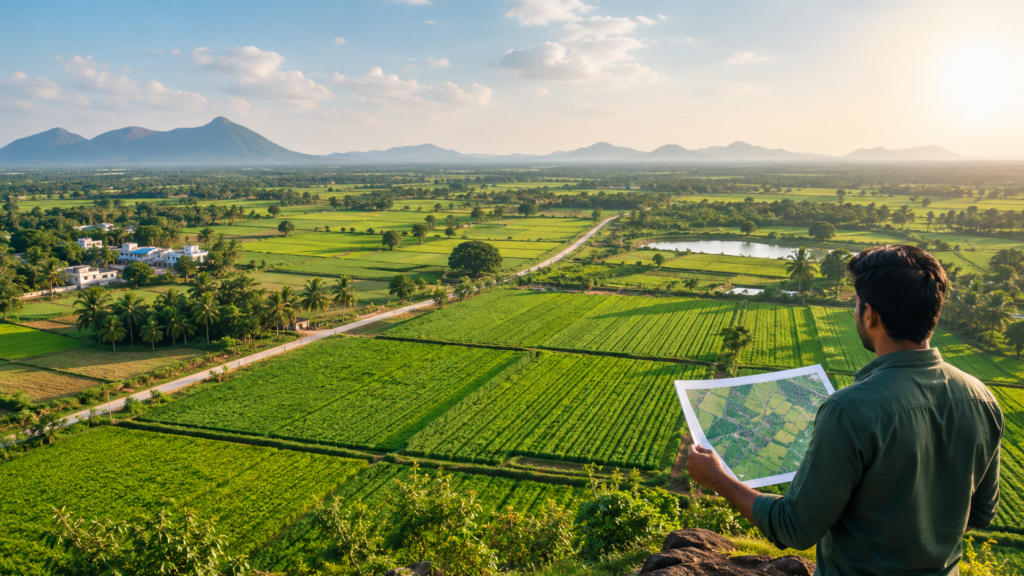

Given its bustling industrial corridors, fast-growing infrastructural facilities, and strong tradition of agriculture, Tamil Nadu is the best place for anyone interested in investing in land. That which used to be considered only a legacy from parents has turned into an instrument of making great wealth, earning tax-free income from agriculture, and making enormous capital gain.
However, the geography of Tamil Nadu is highly diverse. What yields excellent results in one part of the state may turn out to be fruitless in the arid south. To be able to successfully invest in farm land in Tamil Nadu, you need to learn how to differentiate under-performing agricultural lands from productive land.
Here is your guide book to high-growth agricultural lands in Tamil Nadu.
Three-Energy Proximity Model
In Tamil Nadu, the agricultural land value is related to the proximity of the land to the growth engines of the state. The growth regions are invariably found in the expansion area of three main cities.
The Chennai Periphery Growth Engine
The growth of Chennai has created exponential expansion in land values in areas surrounding it. For buying land for farms in Tamil Nadu, the areas that are considered high growth markets are due to the infrastructure developments in the Chennai Periphery Ring Road (CPRR) and the expanding industrial belt of Sriperumbudur and Oragadam.
- High-Growth Pockets of Interest: Kanchipuram, Madurantakam, Uthiramerur, and Acharapakkam.
- The Opportunity: Such pockets provide the perfect mix of current farmland with a strong possibility of turning into either commercial, industrial, or residential belts in the next 7 to 10 years of investment period.
The Western Industrial Belt (Coimbatore-Tirupur Corridor)
Presently, Coimbatore is a leading Tier-2 city in South India. With textbook market principles and educational institutions coupled with logistics, peripheral farm land in Tamil Nadu are witnessing heavy bids.
Infrastructure Catalyst Zone (The Salem-Trichy-Madurai Axis)
These zones are seeing very rapid growth due to extensive connectivity routes like the proposed Madurai metro and the Salem-Chennai Green Expressway.
Soil and Agro-Climatic Intelligence
Tamil Nadu has seven agro-climatic zones. A high growth area would be determined by matching your capital to the biological strength of the soil and climatic characteristics.
Cauvery Delta (The Food Bowl)
Land in Thanjavur, Trichy, and parts of Tiruvarur comprises of deep alluvial and clayey soil. The soil is highly productive but very much reliant on conventional crop cultivation such as paddy and sugarcane. Appreciation of this capital will be steady and assured with the high demands for leasing from local multi-generational farmers.
Red Soil Quartz Belt
Deep, well drained red loamy soil is found in regions such as Western Coimbatore, Dindigul, and parts of Tiruvannamalai. The red loamy soil is extremely fertile and capable of growing high value fruits such as mangoes and avocado as well as high valued commercial trees such as Teak, Mahogany, and Melia Dubia.
Ground Hydrology: Breaking Free from the Dependency on Tanks
Traditionally, Tamil Nadu farming operations have been very tank-dependent. However, according to the current economic analysis by the State Planning Commission, there has been a paradigm shift where surface irrigation is no longer increasing while groundwater sustainability ensures crop yield security.
Rise in Managed Farms and Agri Systems
One of the big changes in farm land in Tamil Nadu is the rapid rise in the popularity of managed farm lands communities. High-potential farm lands can no longer be rated by merely comparing its total acreage; rather it now compares on its operating facilities.
The passive investors, NRIs, and software engineers in Chennai and Bangalore are increasingly drawn towards agri-systems. Places such as Jowlagiri, Denkanikottai, and Shoolagiri (located on the Krishnagiri-Bangalore border) have gained popularity because of this trend.
| Evaluation Metric | Traditional Raw Acreage | Integrated Farm Plots | Managed Farmland Communities |
| On-Site Infrastructure | None (Unfenced, no water source, unpaved or raw trail access) | Basic boundary fencing, shared entry gates, secondary dirt/gravel roads | Automated drip irrigation, 24/7 CCTV & manned security, blacktop roads, solar street lighting, luxury clubhouse |
| Operational Overhead | High (Requires personal labor management, independent vendor hiring, and daily/weekly oversight) | Medium (Relies on finding, supervising, and negotiating with a local tenant or sharecropper) | Zero (100% hands-off “Agriculture-as-a-Service” model run by in-house agronomy teams) |
| Yield & Income Sourcing | Volatile and seasonal; highly vulnerable to crop choices, local market prices, and personal farm knowledge | Moderate stability; bound to standard crop-share arrangements or fixed local cash-rent contracts | High predictability via optimized, long-term timber (Teak/Sandalwood) or high-yield commercial horticulture (Mango/Avocado) |
| Estimated ROI & Growth | Unpredictable; heavily dependent on generic regional land inflation and unexpected local demand | Consistent; aligned with standard agricultural land appreciation patterns (typically 8%–12% annually) | Exponential (12%–17%+ via strategic positioning in high-growth urban corridors combined with value-added plantation equity) |
| Legal Safety & Compliance | High Risk (Buyer must independently execute 30-year due diligence, title searches, and combat encroachment risks) | Medium Risk (Basic document vetting provided, but boundaries are vulnerable if left uncultivated) | Low Risk (Pre-vetted institutional land banks with clear titles, 30-year EC certificates, and secure, gated perimeters) |
| Indian Tax Implications | Tax-free agricultural income under Section 10(1), but complex to systematically track and file | Tax-free agricultural income, though restricted by the tenant’s accounting transparency | Structured, compliant, and tax-free distributions (Section 10(1)) with fully documented annual statements |
| Asset Liquidity & Exit | Low (Challenging to exit quickly; limited pool of rural buyers or hyper-local agriculturalists) | Moderate (Appeals to regional buyers looking for mid-tier semi-developed plots) | High (Strong resale demand from urban corporate professionals, NRIs, and developers seeking premium eco-assets) |
| Lifestyle & Experiential Utility | Minimal; purely functional agricultural use with no leisure spaces or habitable infrastructure | Basic; suitable for a brief day visit, but lacks secondary recreational amenities | Premium (Functions as a personal weekend getaway featuring eco-cottages, resort amenities, and farmstays) |
Through the analysis of where leading farmland development companies are purchasing their land banks, individual investors can confidently recognize the precise geography vectors with the greatest capital appreciation potential.
Due Diligence: Unraveling the Land Titles in Tamil Nadu
A place might be ideal in all aspects of soil quality, proximity to industries, and availability of water, yet without proper land titles, any growth potential is lost. Tamil Nadu has taken great leaps in digitizing land records, making it very easy to verify for modern-day investors.
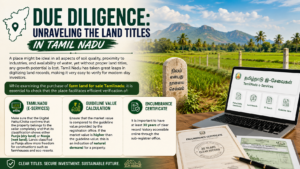
While examining the purchase of farm land for sale Tamilnadu, it is essential to check that the place facilitates efficient verification of:
- Tamilnadu (e-Services): Make sure that the Digital Patta/Chitta confirms that the property belongs to the seller completely and that its classification shows either Punja (dry land) or Nanja (wet land). Lands classified as Punja allow more freedom for constructions such as farmhouses and eco-resorts.
- Guideline Value Calculation: Ensure that the market value is compared to the guideline value provided by the registration office. If the market value is higher than the guideline value, this is an indication of natural demand for a property.
- Encumbrance Certificate: It is important to have at least 30 years of clear record history accessible online through the sub-registrar office.
SBC Earthfulness: The Benchmark for Profitable Ecosystems Through Micromarketing
One such instance could be no other but the project by SBC Earthfulness, complete with its flagship development named A Walk in the Clouds located in the highly desirable Denkanikottai-Hosur region in Tamil Nadu. Being placed strategically between the future district of the Hosur Airport and the STRR, the 200-acre property illustrates how essential micromarketing can be in increasing capital appreciation. Not merely offering passive investors acres of raw and unexplored land, the organization uses the contemporary approaches to agroforestry and utilizes technologies such as drip irrigation to develop an ecosystem consisting of profitable fruit orchards and timber. With such geographical benefits that the location enjoys, it finds itself in a cooler climatic zone than the surrounding cities, thus becoming a better investment than normal farmlands.
Farmland Investment Checklist for Tamil Nadu
To optimize your future gains, ensure your targeted property meets at least four out of these five rapid growth criteria:
- The 90-Minute Test: Lies in a maximum distance of 90 minutes’ drive from the central core area of either Tier-1 or Tier-2 cities on either a busy National Highway or State Highway.
- Infrastructural Accessibility: Lays inside a distance of 15 kilometers of any planned infrastructural project including industrial corridors or expressways.
- Hydrological Rating: Lying within the confines of a CGWB-certified “safe” block where groundwater can be reached under 300 feet depth.
- Soil Classification: Made up of Class I/II red loam or alluvium soil suitable for cultivation of various types of fruits and timber plantation.
- Clean Digital Land Records: Fully digital Patta/Chitta document belonging exclusively to the current owner for 30 years.
Conclusion
Locating a high-growth area for farm land in Tamil Nadu will require moving past the picturesque image of rural India and focusing on the economic realities behind it. With an investment in agricultural lands close to growing cities, diverse soil conditions, and guaranteed access to water, not only will you be building a secure source of wealth but you will also be making it grow.
FAQs
Q1. Which areas within Tamil Nadu today give the greatest capital appreciation from farming lands?
Chennai outskirts (Kanchipuram, Madurantakam) and Coimbatore industrial areas (Pollachi, Kinathukadavu) provide maximum appreciation owing to extensive industrial expansion and proximity to highways.
Q2. Is it possible for someone who doesn’t work in agriculture to buy farming lands for sale in Tamil Nadu?
Yes, as opposed to many nearby states, it’s possible for anyone to purchase up to 59.95 standard acres of farm land in Tamil Nadu, as long as the land deed is free from any disputes.
Q3. What impact does the nature of land (Nanja or Punja) have on returns from investment in farmlands?
Punjab is better suited for investments since it gives greater flexibility in obtaining permission to construct farms, low chances of land boundary disputes, and is suitable for timber plantations and farmhouse developments.