


If you have ever dreamt of owning a small piece of farmland, or maybe growing your own food, you are not alone, and that’s actually a dream of many! In fact, a lot of people are now buying agricultural land in India, and looking for that slower, more grounded life.
But here is what most people do not tell you: The price you see on paper is usually never the whole price. There is a quite list of extra charges that come crawling in later, like taxes, paperwork, clearances, and fees you didn’t know even existed. These are what we like to call agricultural land hidden costs, and trust us, they can make a big difference if you don’t plan for them.
So, let’s walk through all those lesser-known expenses and how SBC Earthfulness keeps things more transparent, stress-free, especially if you’re looking for managed farmlands.
Hidden Costs You Should Know About
Before we dive into each one, here’s a quick reality check: buying land is not just “price × acres.” When you’re buying agricultural land in India, there are government charges, legal formalities, and setup costs that quietly pile up. And before you know it, your bank balance is running in the negative because, well, you didn’t plan!
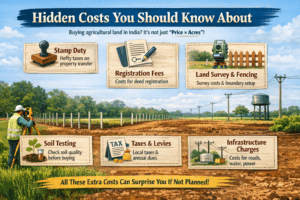
But hey, many people miss these things because they are not shown upfront. So let’s go through all these extra charges, which can make you change your mind last moment if not planned well:
-
Stamp Duty
The first and biggest charge that catches people off guard is stamp duty on agricultural land. This is basically the tax you pay to the state when you officially transfer land ownership to your name. Now every state has its own rate of stamp duty on agricultural land. On one hand, where some charge around 5-6%, others might charge a larger chunk.
For example, if your land costs ₹20 lakh, and your state’s rate of stamp duty on agricultural land is 6%, that’s ₹1.2 lakh gone right there. Yes! That’s just for stamp duty. Not to mention, this number can go up!
-
Registration/Deed Recording
Once you pay your stamp duty, the next step is getting the sale deed registered at the local sub-registrar’s office. That’s where land registration fees come in. This is the step where your purchase becomes official, so without this, your name will not go on the government records. So how much does it cost? Well, the land registration fees usually range from 1-2% of the property’s market value.
That might sound simple, but document handling, scanning, notary, service fees, clerical changes, and basically all the tiny extras go into this, which no one will mention to you!
-
Survey, Fencing, Marking
Now that your paperwork is sorted, it’s time to figure out where your land actually starts and ends. For this, there is a proper land survey which is approved by the government. And well, it sounds easier than it is as the process can take a long time, which means higher fees too!
Then comes boundary marking and fencing. Most people don’t think about it until they have to, but fencing isn’t cheap. And the tricky part? Your neighbours might not get along well with the whole idea of this, and raise a dispute or even claim an overlap. So a re-survey can also be there. Which is why Land surveys and fencing may not sound like a big deal, but they’re among the most common agricultural land hidden costs that catch buyers off guard.
-
Soil testing / Regulatory Clearances
This is where things start to get a little technicist’s but it’s important to look into it. When you are buying agricultural land in India, it might look perfect from the surface. You will see a green, fertile, picture-ready space, but what actually matters is what’s underneath. Any guesses what that is? Well, if you guessed soil, you are right!
Testing the soil is very important before you buy is one of the smartest things you can do. It tells you whether the land is actually cultivable or if you will need to invest in improving its quality later!
Also Read : Is Agricultural Land Still a Good Investment in 2025?
-
Taxes, levies, cess
Want to hear a sad part? Even after the land is yours, the bills don’t exactly stop showing up. Sure, agricultural land is usually away from a lot of mainstream taxes, but there are always a few local ones that quietly sneak in. It can be property taxes, land revenue, or those small maintenance fees that show up every year at your door.
So if one fine day, you wish to convert your farmland into something else, like residential or commercial use, then you’d better be ready to separate the conversion fee waiting for you down the road.
-
Infrastructure/Development Charges
This one is a big deal, especially if you are not buying from a managed farmland developer. Because you purchase raw agricultural land, there is usually nothing there. Like no roads, no power, no water connection, no fencing, no drainage. So if you go about building that infrastructure later, that would cost you a fortune.
So make sure you are counting in internal roads, electricity poles, borewells, water tanks, pumps, etc. Basically, infrastructure is truly one of the most underestimated agricultural land hidden costs.
What Makes SBC Earthfulness Different?
Now, if all of this sounds like a lot to manage, that’s where SBC Earthfulness stands out and makes it easier than ever. We offer managed farmland projects, which means you don’t just buy a piece of land, but also peace of mind. Unlike many others, here, we make sure you get:
- Transparent pricing
- End-to-end support
- Eco-smart amenities
- Sustainable options
Because let’s be honest, when you are buying agricultural land in India, you’d better go for a trusted, transparent developer. This way, you save time, stress, and literally avoid a huge part of those agricultural land hidden costs.