


For decades, when people talked about wealth creation, one phrase dominated every conversation: real estate investment. You can buy an apartment, rent it out, wait for it to appreciate, and repeat. That model worked out well for a long time. But today, with changing times and systems, many investors are rethinking the whole model of investment in the real estate industry.
These changes include rising property prices, lower rental yields, maintenance headaches, and market volatility. These have started to expose the cracks in traditional real estate investment. At the same time, another asset that has been gaining attention for all the right reasons is farmland investment. This is where you can get stability and real value. This is where buying a farm as an investment enters the conversation.
In this article, we will break it all down for you and discuss how SBC earthfulness is making this transition accessible to young investors as well. So without any further ado, let’s get right into it!
What Is Farmland Investment?
At its core, farmland investment is basically owning an agricultural land that is actively managed to generate returns over time. And unlike land purchases, this model focuses on productive land, which grows crops, supports ecosystems, and steadily appreciates in value.
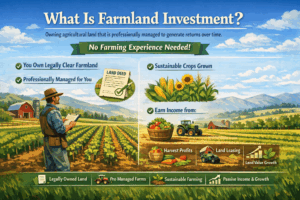
So when people think of buying a farm as an investment, they often imagine hands-on farming, daily supervision, or having a great amount of agricultural knowledge. This assumption is the one keeping you from getting into farming. Good for you, modern farming investing, especially through managed models like ours, helps you to remove this barrier.
With a managed farmland model:
- You own a legally clear parcel of agricultural land
- The land is professionally managed
- Crops are grown using sustainable practices
- Income comes from agricultural yield, leasing, or long-term appreciation
These factors are what make farmland different from passive land banking. Now you don’t have to wait every day for the development or rezoning. Once your land is already productive, it will work for you! But most of all, there is one more thing farmland has that most of your assets don’t. It’s the intrinsic demand. People always need food, and that single fact gives farmland investment a level of resilience that many forms of real estate investment struggle to match!
Today, as an investor, you can see farmland not just as a piece of land, but as:
- A hedge against inflation
- A diversification tool
- A stable, low-volatility asset
- A long-term wealth builder
This is why if you ever ask a seasoned investor, they would tell you that the best way to invest in farmland is to go for a managed farmland that is professionally taken care of by SBC Earthfulness.
Traditional Real Estate Investment vs. Farmland Investment
To truly understand why farmland is gaining more attention, you need to compare it honestly with traditional real estate investment. Here is all you need to know:
| Factor | Traditional Real Estate Investment | Farmland Investment |
| Entry Cost | High upfront capital | Lower entry points available |
| Cash Flow | Rental dependent, vacancy risk | Crop yield + land appreciation |
| Maintenance | High (repairs, tenants, society issues) | Professionally managed |
| Market Volatility | Strongly affected by cycles | Relatively stable |
| Inflation Protection | Moderate | Strong |
| Emotional Value | Mostly financial | Financial + lifestyle |
| Long-Term Demand | Urban saturation risk | Food demand is constant |
That’s the thing with real estate investment! Your returns get tied up to multiple unpredictable factors like tenant behavior, building wear and tear, local infrastructure changes, and market oversupply. On the other hand, with farmland investment, it’s literally land and nature. Land that grows food and will increase in value as the population rises. Basically, sustainability becomes a non-negotiable.
Also Read : Managed Farm Land vs. Residential Plots: Which Investment Is Smarter?
Why Farmland Investment Is Outsmarting Traditional Real Estate
This shift that we are talking about is not accidental. It’s happening because farmland is solving the pain points of investors that are pretty common when buying property. Here is how and why farmland investment is outsmarting traditional real estate:
-
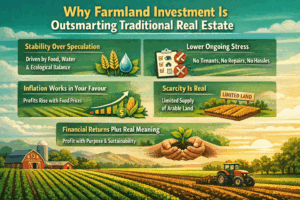
You Get Stability Over Speculation
One of the biggest frustrations with traditional real estate investment today is how unpredictable it has become. The prices here are based on the market sentiment, policy changes which literally alter your returns overnight. So what once felt like a “safe bet” now rather feels like guesswork. On the other hand, farmland investment doesn’t depend on hype or short-term market noise. Here factors like food production, water access and ecological balance is what drives the value. And well, these will never disappear!
-
Lower Ongoing Stress
Anyone who owns property will tell you the same thing: real estate investment is rarely as passive as it sounds on paper. You will see how the tenants come and go, repairs pile up, society issues pop up unexpectedly, and legal or documentation follow-ups become part of your routine. Over time, what was meant to be an investment starts feeling like a responsibility, which is not the case with managed farmlands. Especially when buying a farm as an investment through a structured platform like SBC Earthfulness, there’s no day-to-day involvement required from you.
-
Inflation Works In Your Favour
We all know how inflation literally affects every asset, and this is where traditional real estate investment struggles, too. Over time, this keeps getting out of your hands and pockets. Farmland’s however, behaves differently. As inflation rises, food prices naturally move up with it. So that’s a win-win for you! You will own a land that becomes more valuable, not less. This is what makes farmland investment one of the strongest natural hedges against inflation.
-
Scarcity Is Real
Cities can grow taller, and buildings can go higher. Farmland doesn’t work that way, as here, you get a limited cultivable land. That very scarcity is what supports the long-term appreciation of farmland investment. As the demand for food will rise and the usable land becomes harder to find, well-managed farmland naturally becomes more valuable than any other taller and higher asset!
-
Financial Returns Plus Real Meaning
Last but not least, most forms of real estate investment are purely transactional. You buy, you rent, you sell. The relationship ends there. But with farmland, you get something deeper. Beyond the financial returns, you get a connection to nature, sustainability, and a meaningful asset. And that’s why, today, farmland is no longer just an alternative asset. It’s a thoughtful, future-facing investment choice.
Conclusion
The world of investment is evolving. What worked four years ago does not really work today. While we cannot deny that traditional real estate investment still has its place in the market, it no longer holds the monopoly on stability or long-term growth. And well, considering its rising costs, lower yields, and stress, investors are now looking beyond apartments and commercial spaces.
Farmland investment answers that need with clarity like never before. Here, you get the stability and value that is not very common in the fluctuating market. So if you are someone who is planning on buying a farm as an investment, then the key lies in choosing the right model. For you, managed farmland like what SBC earthfulness offers, will remove the risks and simplify the overall process! So in a world where food security, land scarcity, and sustainability matter more than ever, you can be a part of a great cause and outsmart real estate.